


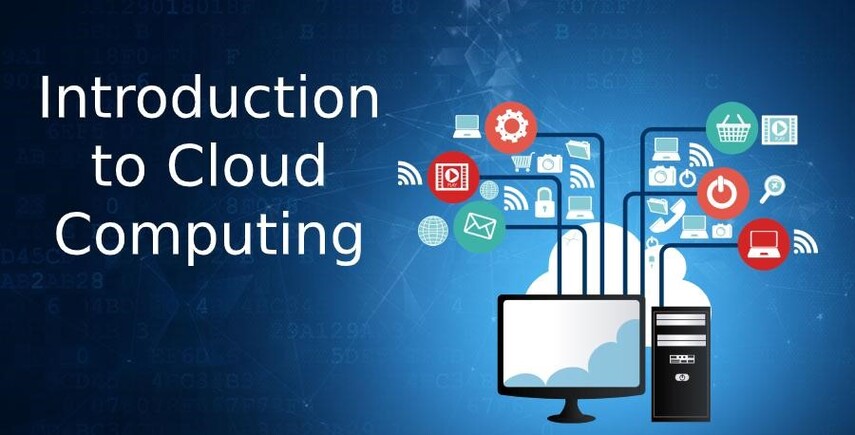
Cloud Computing is the delivery of computing services such as servers, data storage, databases, networking, software, analytics, and intelligence over the internet ("cloud") to offer flexible resources, faster innovation, and economies of scale. Rather than investing in their own data centres, businesses may rent access to another party's infrastructure and only pay for the resources they actually use.
Your operational expenses may be reduced, infrastructure can be operated more effectively, and applications can be scaled to meet business requirements by only paying for the cloud services you really use.
Cloud Computing gives an alternative to the on-premises data center. With an on-premises data center, we have to manage everything: acquiring and installing hardware, virtualization, installing the operating system and other software, setting up the network, establishing the firewall, and setting up storage. We are then in charge of sustaining it throughout its whole existence.
However, if we pick cloud computing, a cloud provider is in charge of the hardware's acquisition and upkeep. They also provide a huge selection of software and platform as a service. The user may manage compute, storage, network, and application resources with ease thanks to the cloud environment's conveniently accessible online interface.
Who Uses Cloud Computing?
Building customer-facing online apps, data backup, delivering email/SMS notifications, virtual desktops, software development and testing, big data analytics, and disaster recovery are just a few of the many use cases that organizations of all shapes, sizes, and sectors are adopting the cloud for. Telecom firms use cloud services to communicate with clients by transmitting messages. Financial services companies use the cloud to provide real-time fraud prevention and detection.
Characteristics of Cloud Computing
On Demand Self Service. The usage of web services and resources is made possible by cloud computing. A website may be accessed at any time and used by anybody.
Broad Network Access. Since cloud computing is completely web based, it can be accessed from anywhere and at any time.
Resource Pooling. Cloud computing allows multiple tenants to share a pool of resources. One can share a single physical instance of hardware, database and basic infrastructure.
Rapid Elasticity. The resources can be scaled either horizontally or vertically at any moment. The capacity of resources to scale up or down in response to demand is known as resource scaling.
Measured Service. The cloud provider controls and monitors all aspects of cloud service. Resource optimization, billing, and capacity planning depend on it.
How Does Cloud Computing Work?
Let's break cloud computing into its front end and back end. The client's computer or computer network makes up the front end. The cloud's back end is made up of multiple computers, servers, and data storage platforms, linked through a network, most frequently the Internet. The user's side is the front end; the "cloud" portion serves as the back end.
Cloud Computing Deployment Models
The deployment models specify different types of clouds. Every organization has different needs and must determine which model works for them. There are mainly three:
1. Public Cloud. A collection of hardware, networking, storage, services, applications, and interfaces owned and run by a third party and made available to other businesses or people. Commercial providers construct a highly scalable data centre and conceal the underlying architecture from the customer.
2. Private Cloud. A collection of hardware, networking, storage, services, applications, and interfaces owned and run by a company and available to its partners, customers, and workers alone. A private cloud is a tightly regulated setting off limits to the general public — essentially another method of managing an on-site data centre.
3. Hybrid Cloud. Made up of both a private cloud and the use of public cloud services, combining the two to address business issues. A hybrid cloud allows better flexibility, more deployment options, and helps optimise infrastructure, security, and compliance by enabling data and applications to flow between private and public clouds.
Types of Cloud Services
1. Infrastructure as a Service (IaaS). Lease IT infrastructure — servers, virtual machines, storage, networks, and operating systems — from a cloud provider. IaaS gives the most freedom, but upkeep still requires more work.
2. Platform as a Service (PaaS). A flexible environment for creating, testing, distributing, and maintaining software applications. The vendor offers the capacity to deploy and run the programme, while the developer creates it. Freedom is decreased, but the environment is managed by the supplier.
3. Software as a Service (SaaS). A centrally hosted and managed software solution delivered on demand via subscription — for example, Office 365, Dropbox, WordPress, OneDrive, and Amazon Kindle. SaaS minimizes operating costs.
Cloud Computing Examples and Use Cases
If you use an online service to send email, edit documents, watch movies or TV, listen to music, play games, or store pictures, you are likely part of a cloud ecosystem.
Test and Development. IT companies use cloud services as a development environment. DevOps teams can swiftly create development, testing, and production environments, with physical and virtual computers provisioned automatically.
Big Data Analytics. A massive amount of data is collected each day from cloud applications, IoT devices, and users. Cloud computing lets organizations leverage that computing power.
Cloud Storage. Files may be automatically saved to the cloud, then viewed, stored, and retrieved from any device with an internet connection. Organizations pay only for the storage they use.
In conclusion, cloud computing is a relatively young technical innovation with enormous potential for global effect. It lowers operational costs by focusing more on the business itself and paying less on upkeep and software upgrades. There are still difficulties — people have doubts about how safe and private their data is, and worldwide norms or laws do not yet uniformly apply. But once there are standards and regulations worldwide, cloud computing will revolutionize the future.
Comments
Anna Colins
26 Jan 2023
A fascinating read! The way this topic continues to reshape how we approach technology and business is remarkable. Looking forward to more insights from the Sodel Solutions team.
Tomm Ostin
26 Jan 2023
Very well explained. This is exactly the kind of deep-dive content I was looking for. The examples make the concepts much easier to grasp.